
Mahamudra Shamatha: Settling and Steadying the Wayward Mind
With Lama Eric Triebelhorn
June 26 - 30, 2026
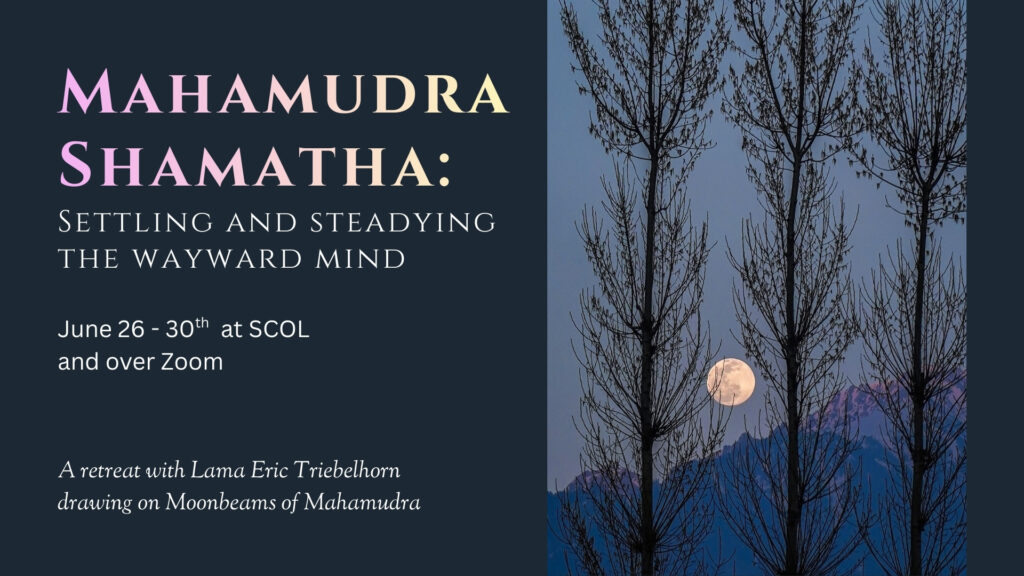
In the wisdom tradition of Mahamudra, the essence of shamatha (calm abiding) practice is resting in the knowing quality of mind. We cultivate this skill by recognizing that aspect of our being that is aware and training it on various supports to sustain the experience. This is essential practice can enhance all aspects of our Buddhist practice as well as our daily life. Developing shamatha, we begin to loosen the grip of discursive thinking and the afflictions that cause so much difficulty for ourselves and others and further begin to nurture the inner conditions from which genuine insight into the nature of mind can arise.
This four-day silent retreat offers an immersive opportunity to explore and deepen shamatha practice through the lens of one of the great classical Mahamudra texts, Dakpo Tashi Namgyal’s Moonbeams of Mahamudra. Drawing directly on this revered source, the retreat will offer guided meditation sessions working with a variety of traditional supports. Additionally, participants will have the opportunity to sit on their own, giving the teachings a chance to take root through direct personal experience. There will further be daily opportunities for questions and discussion, ensuring that instructions are well understood and practice difficulties can be addressed.
To minimize distractions and create a container for sustained awareness, this retreat will be held in noble silence. This will support the kind of sustained attention that shamatha practice invites. Those newer to this meditation can expect clear instruction, meaningful exposure to the practice, and the development of a degree of confidence to continue sitting on one’s own. Seasoned practitioners will find the spaciousness and continuity of silence ideal for settling more deeply into the subtleties of sustained awareness.
Quiet, secluded, and spacious, our rural retreat center, Ser Chö Ösel Ling (SCOL), provides an ideal environment for meditation practice. The generous meal breaks will offer time to explore our 240 acres and its many trails and wildlife. In addition to lodging, three nourishing vegetarian meals will be provided daily. The retreat can also be attended online via Zoom. The online option is available on a sliding scale so that anyone for whom travel or cost is a barrier can still fully participate.
This retreat is held as a shared practice container, and we ask that everyone who registers, whether attending in person or on Zoom, plan to be present for all sessions. Recordings will be available as a reference for those who attend live, but not as an alternative way to take part.
Book References
Though you need not have read nor bring any books to participate in the retreat, most of the meditations and teachings will be drawn from Dakpo Tashi Namgyal’s Moonbeams of Mahamudra. Elizabeth Callahan’s translation is the most recent and complete. Traleg Kyabgon also has a version entitled Moonbeams of Mahamudra: The Classic Meditation Manual and Thrangu Rinpoche’s oral commentary is captured in Essentials of Mahamudra.
Retreat Schedule
The retreat opens on Friday, June 26 with dinner and an evening session and ends on Tuesday, June 30, with a closing session and breakfast in the morning. For retreat days, the schedule will be as follows:
AM
6:30 – 7:30 am Group meditation
7:30 – 9:00 am Breakfast break
9:00 – 10:30 am Teaching and meditation
10:30 – 11:00 am Tea break
11:00 – 12:00 pm Self-guided practice
PM
12:00 – 2:30 pm Lunch break
2:30 – 4:00 pm Meditation and discussion
4:00 – 4:30 pm Tea break
4:30 – 5:30 pm Teaching and meditation
5:30 – 7:00 pm Dinner break
7:00 – 7:45pm Evening chanting and prayers
About the Leader
Lama Eric Triebelhorn
Lama Eric Triebelhorn first came to KCC not long after graduating from college and quickly immersed himself in the center’s activities. He served as Board president for four years and was the first caretaker of our retreat land, Ser Chö Ösel Ling. In 2002, he moved to India to study Tibetan language and practice with […]
Learn more about Lama Eric TriebelhornCategory : 5120 Retreat SCOL